To put it briefly: Learning any language is hard work and not always enjoyable.
In some rare cases, you might really get a kick out of a language, but that’s the exception rather than the rule.
There are loads of different methods, and it’s hard to work out which one works best for you. There are a huge number of factors:
age, health
type of work
psychological and emotional state
living environment
social circle, social interactions and social status
which language did you study at school before...
The list could go on, but I’m no expert, and I can say that there are some fundamental factors that influence language learning:
Hearing (ears)
Pronunciation (voice)
Reading (brain – analysis)
All three of these conditions must be met. Nobody knows in what proportions! Believe me. If you’re reading this, it must be true.
Another truth is that you won’t find a complete language course (English, Spanish) on this website. This is just a small part of the learning process. Language tutors, reading books and listening to podcasts are very effective. If anyone claims that there is just one single method – don’t believe them. Any method will eventually reach its limits. And, most importantly, it is useful at a certain stage of language learning.
The learning method on Sayly.uk
The method is based on context-based phrases, spaced repetition, repeating after the speaker, and translation from one’s native language into the target language.
Let’s get started
Select your native language (RU) and the language you’re learning (EN or SP)

Sign up for free – there are no further charges or promotional offers. All content is free and requires no subscription!
Each lesson contains a certain number of words and examples of their use in context.
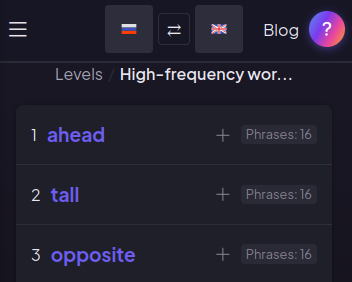
Click on the heading and a list of sentences will appear. On the left (line-by-line layout on mobile) are the sentences in your native language (highlighted). On the right is the language you are learning.
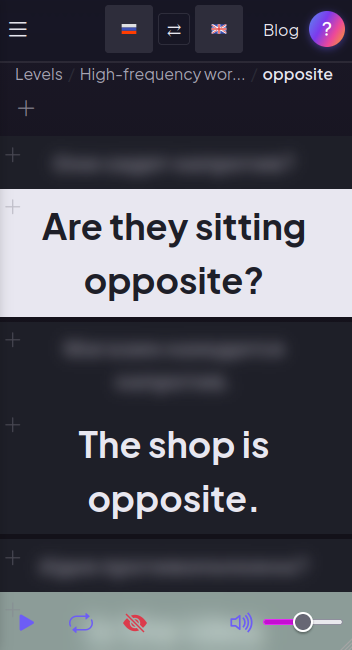
There is a player at the very bottom. The ‘eye’ icon turns off the blur effect. You can also turn off the blur effect by holding your finger or the mouse pointer over the invisible text.
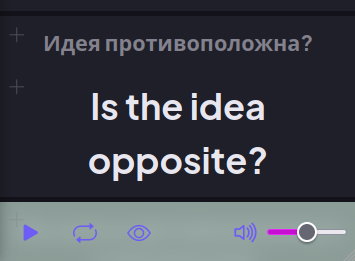
The arrow button plays the audio.
As soon as you hear the sentence, repeat it and try to translate it. Make sure you get the key phrase right!
A simple click on the sentence plays it once.
The ‘loop + arrow’ icon plays the audio continuously, with a pause so you can repeat after the speaker (shadowing).
Another effective learning method is when you ‘switch’ between a couple of languages (the arrows between the languages at the top). You’ll see your native language. Say the translation aloud, then compare it and listen to check whether you’ve pronounced it correctly.
I’ve forgotten everything I learnt
You’ve probably already guessed that after reading and listening to such texts, you’ll quickly forget it all – and that’s true.
To make sure you don’t forget what you’re learning, you need to repeat it many times. In the lessons and phrases interface, there’s an ‘Add to Track’ icon.
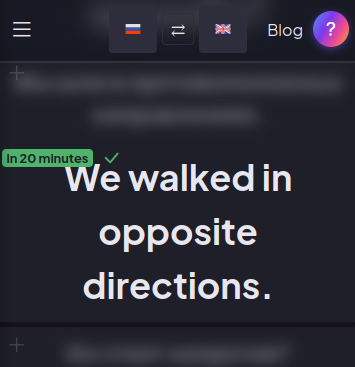
As soon as you click on the “+” button, the phrase or lesson is added in its entirety to your tracking list. This means that the revision interval is activated: after 20 minutes, after 1 hour, and after 24 hours. Why 20 minutes? This is a standard observation showing the maximum rate of forgetting, which is around 60 per cent within the first 20 minutes of receiving the information.
Next, Hermann Ebbinghaus’s mechanism comes into play. He developed a system for how information is forgotten over time—you can read about the details online. But that doesn't really matter; the bottom line is that you need to review the material, and you know that yourself.
The app will remind you when it’s time to review the sentences, displaying a badge with a timer.
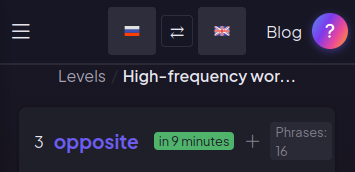
In my personal opinion, I believe that repeat notifications should be unobtrusive, and you should decide for yourself when to study or whether to tick the ‘track progress’ box at all.
Regarding the voiceover: all voices on this site are generated by AI. Generally, the voice quality is high, though there may be occasional audio glitches—please disregard them.
Very important
Repeat after the speaker out loud, and if you can’t get it right, keep trying again and again. This is incredibly important – it works like a speech therapy exercise. The more often and more clearly you pronounce the words, the better the result.
Good luck
Comments 0
No comments in this language yet. Be the first!